
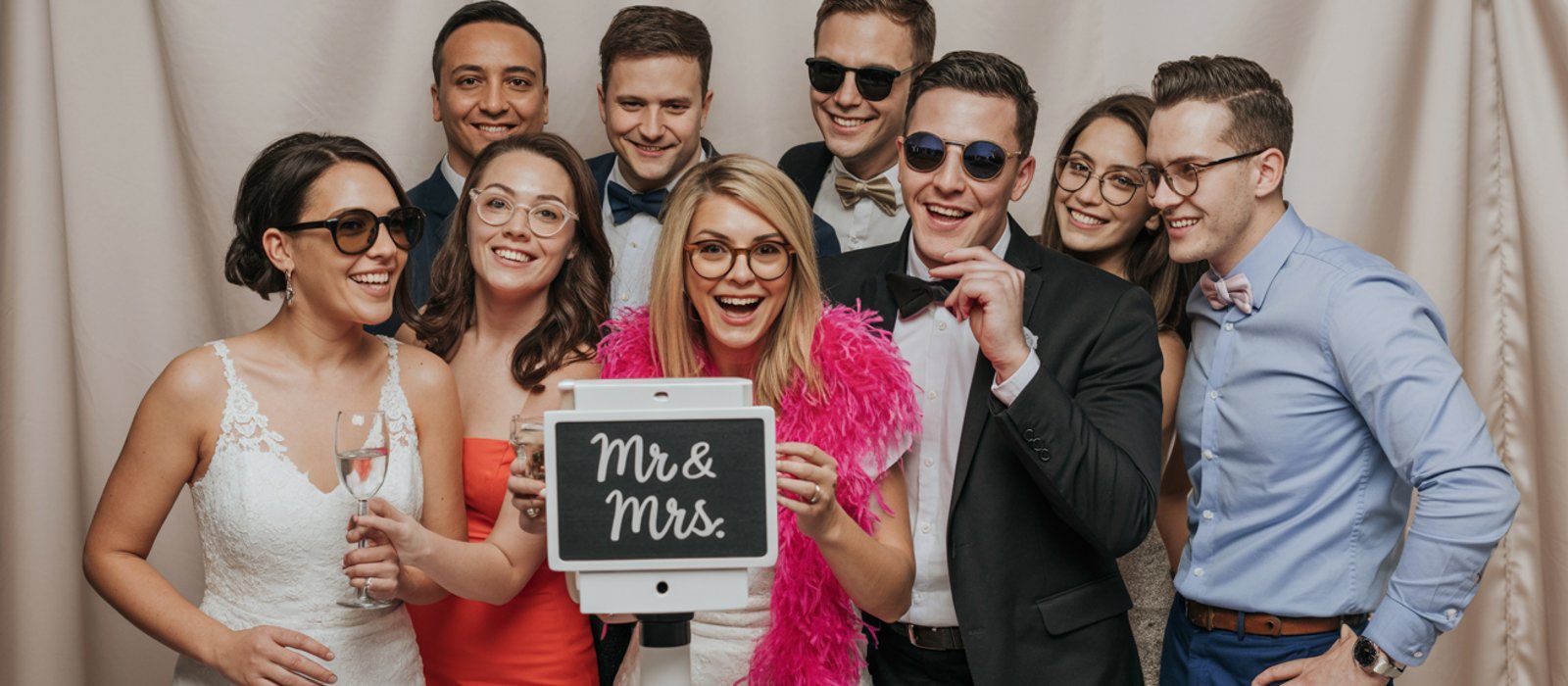
There's a photo booth in the corner. It has a ring light, a feather boa, and a chalkboard sign that says "Mr & Mrs." Nobody has used it since the canapés. This is not a crisis you invented — it's a pattern. Couples spend a meaningful chunk of their budget on guest entertainment, only to watch everyone gravitate towards the free bar and their own camera rolls. The result? A hundred near-identical group selfies and a photo booth printout strip that lives in a kitchen drawer until the next house move.
If you're a wedding planner or venue coordinator in the UK, you already know the brief has changed. Couples want photo moments that feel designed — visually distinctive, genuinely interactive, and socially shareable in a way that doesn't require a hashtag printed on a napkin to encourage participation. Here's how to actually deliver that.
Understand Why Most Wedding Photo Moments Fail the Share Test
Before you fix the problem, it helps to understand the mechanics of why something gets shared versus why it gets quietly forgotten.
Guests share wedding photos when they look good and when the image has a story attached to it. A standard photo booth delivers neither particularly well — the backdrop is generic, the props are identical across every wedding that hired the same kit, and the resulting image looks like every other photo booth image on the internet.
Contrast that with a guest who steps inside a giant gilded portrait frame and strikes a pose as though they're a seventeenth-century aristocrat. That image has narrative. It has novelty. It has a caption already half-written in the guest's head before they've even pressed the shutter. The difference between a forgettable photo moment and a shareable one is almost always story.
When briefing clients on wedding entertainment ideas UK options, it's worth framing it this way: you're not just choosing an activity, you're choosing what story guests tell about the wedding on Monday morning.
Lean Into Visual Distinctiveness Over Visual Familiarity
The safest creative choice — the one that looks fine on a mood board and disappoints on the day — is usually the familiar one. Neon signs, mirror selfie stations, polaroid walls: these have their place, but they no longer stop the scroll. Guests have seen them. Their cameras have already taken those photos somewhere else.
The interactive wedding photo experiences that actually travel — that end up on Instagram Stories, in WhatsApp group chats, in the background of a LinkedIn post about something entirely unrelated — are the ones that look like nothing else at the last five weddings your guests attended.
This is where art-history-inspired installations earn their keep. A face-in-hole board styled as a period painting, for example, is visually specific in a way that generic prop hire simply isn't. Guests aren't holding a comedy moustache on a stick; they're inserting themselves into a genre of image with centuries of cultural weight behind it — and doing it with enough irreverence to make it funny. That combination of high-brow reference and low-brow execution is, as any meme theorist would tell you, almost algorithmically optimised for sharing.
The National Self Portrait Gallery's hire boards work on exactly this principle. Each one is a bespoke, art-gallery-quality painted portrait with a face-shaped aperture — so guests don't just take a photo, they become the painting. The results look unlike anything else in a wedding gallery, which means they get shared precisely because they stand out.
Place Your Photo Moments Strategically, Not Decoratively
Even the most visually striking installation will underperform if it's treated as decoration. Placement and timing matter as much as the object itself.
A few principles worth building into your event flow:
Put it where the dwell time is naturally high. The drinks reception is gold for this — guests are relaxed, slightly giddy, and not yet corralled into the formal programme. They have time to play. A photo installation placed here will see more use than the same installation tucked beside the dance floor at 10pm when the only light source is a disco ball.
Make it part of the narrative, not an afterthought. If you're working with a couple who have a shared love of art, travel, history, or just an aesthetic sensibility, commission or hire something that reflects that. Guests notice when an installation has been chosen rather than defaulted to, and that perception of intentionality makes them more likely to engage and share.
Brief the wedding party. The fastest way to seed engagement with any interactive element is to have the bridal party use it first and visibly. If the best man has already posted his portrait by 3pm, half the room will have followed suit by 5pm. Social proof works at weddings exactly as it works everywhere else.
For unique wedding guest activities UK planners are offering, the ones that generate the most organic coverage tend to be those where the couple themselves are clearly enthusiastic. That enthusiasm is contagious, and it photographs well.
Think About the Image After the Event, Not Just During It
Here's a question worth putting to every couple you work with: What do you want your wedding to look like on social media six months from now?
It's not a cynical question — it's a practical one. The images that resurface on anniversaries, in roundup posts, in venue marketing, and in couples' own social feeds are the ones that were visually interesting enough to warrant a second look. A photo of someone genuinely laughing inside a gilded portrait frame has a longer shelf life than a posed shot in front of a flower wall.
This is also worth bearing in mind if you're a venue looking to build your own content library. Interactive photo experiences generate images that you can use — in your own marketing, on your website, in press submissions. A wedding that produces genuinely distinctive imagery benefits everyone in the supply chain.
When briefing suppliers on interactive wedding photo experience hire, ask directly: what does the finished image look like? Not the installation — the photograph. If the answer is vague or generic, that's worth noting.
The Takeaway
The photo moment question at weddings is ultimately a content question: what are you giving guests that's worth creating, sharing, and keeping? The answer isn't more props or a better ring light. It's a more considered choice of experience — one that gives guests a story to tell and an image that looks like nobody else's wedding.
That's a higher bar than a feather boa in a photo booth. It's also not a particularly difficult bar to clear, if you're commissioning the right things from the start.
Interested in hiring a face-in-hole portrait board for a wedding or event? Get in touch with the National Self Portrait Gallery to discuss bespoke options and availability.