
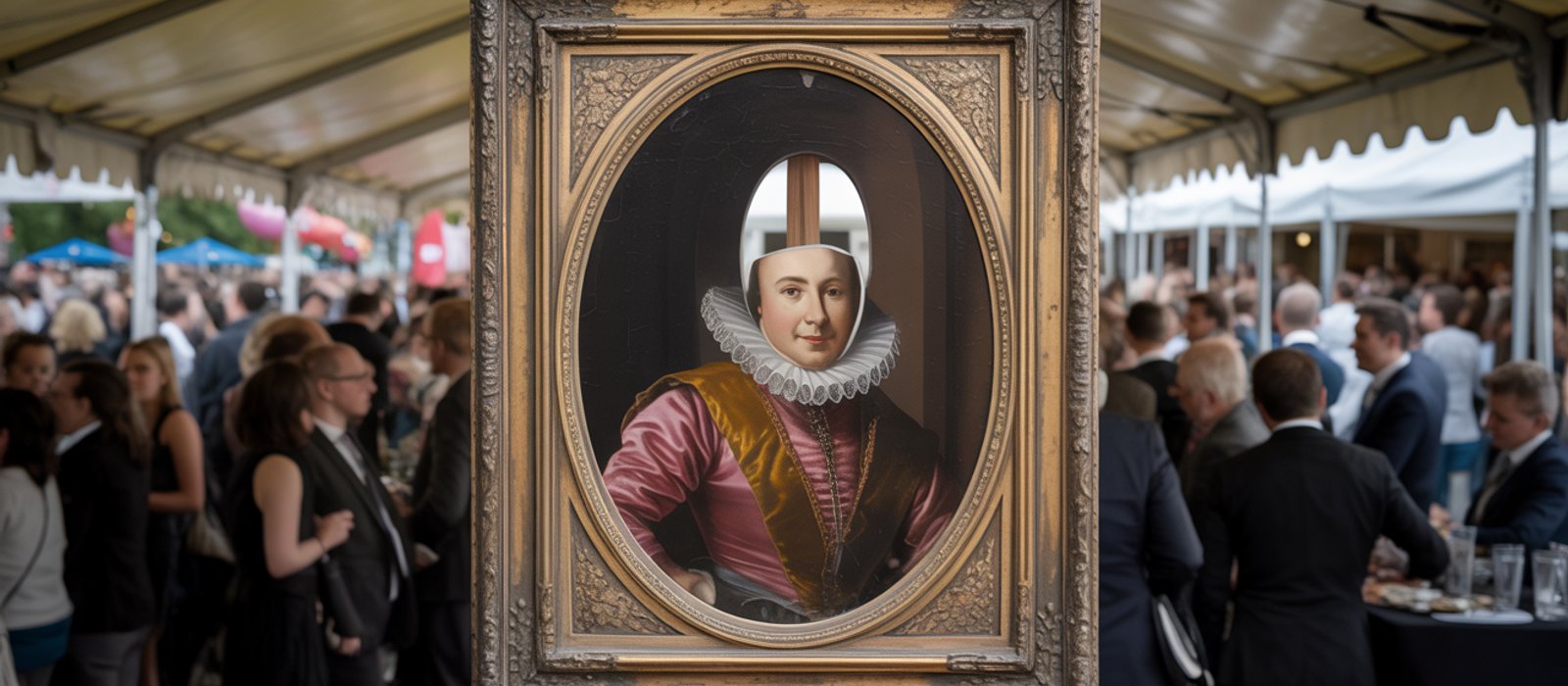
Picture the scene. It's your product launch. There's a step-and-repeat banner in the corner — your logo, repeated seventeen times at a jaunty diagonal — and a queue of three people, all of whom work in accounts payable. Meanwhile, on Instagram, your competitors are generating hundreds of organic posts from their events while your branded backdrop gathers metaphorical dust.
The problem isn't your product. It's your activation.
Selfie marketing at events has become one of the most cost-effective tools in the experiential marketer's kit. But most brands are still playing it safe with setups that guests tolerate rather than seek out. There's a better way — and it's been hanging on gallery walls for five centuries.
The Psychology of the Shareable Moment
People share things that make them look interesting, funny, or culturally aware. A photo standing in front of a logo does none of those things. A photo where your head emerges from a Tudor noblewoman's ruff? That does all three simultaneously.
This is the core insight behind face-in-hole portrait boards, and it's grounded in fairly straightforward social psychology. When someone shares a branded backdrop photo, they're essentially doing your marketing for you against their own interests — the content is about the brand, not them. When they share a portrait photo, they're the subject. The brand earns the ride along.
The result is that face-in-hole boards consistently generate higher organic reach than traditional branded photography setups. Guests tag friends. Friends share it. People who weren't at your event see a funny, well-composed image and ask where it came from. That's earned media, and it doesn't cost you a penny beyond the hire fee.
For anyone developing interactive brand activation ideas in the UK right now, the question isn't whether to include a shareable photo moment — it's whether your current setup is actually earning those shares.
Why Art History Is Your Unexpected Competitive Advantage
There's something specific about classical portraiture that cuts through in a way that a neon sign or an inflatable arch simply doesn't.
When you slap your brand onto a generic backdrop, you're adding to the visual noise that attendees are already exhausted by. When you place your brand in the context of a meticulously reproduced Old Master — a Holbein, a Vermeer, a Van Dyck — you're doing something entirely different. You're giving people a moment of genuine delight.
The contrast is the point. A very modern face peering out from a very old portrait is inherently funny. It's also inherently interesting, in a way that a logo grid simply isn't. People stop. They look. They queue. They post.
From a brand positioning standpoint, this matters more than it might seem. What people feel when they interact with your activation becomes part of how they feel about your brand. If your setup says "we thought about you and wanted to give you something genuinely fun," that lands differently than "please stand here and help us reach our impressions targets."
This is why face-in-hole portrait boards have become a genuine fixture in product launch entertainment hire across the UK — particularly at launches where the brand wants to signal wit, creativity, or cultural confidence without being precious about it.
Making It Work: Practical Choices That Affect Your Results
Not all portrait boards are equal, and the details matter for selfie marketing at events.
Scale is everything. A board that's too small looks like an afterthought. A full-height portrait — the kind you'd see in an actual gallery — creates a genuinely impressive visual and photographs dramatically better. It also signals that you've invested in the experience, which guests register even if they don't consciously clock it.
Placement determines footfall. Put the board where people congregate naturally — near the bar, beside the registration desk, in the flow between spaces — rather than tucked into a corner. The best interactive brand activations work with the space, not against it.
Customisation is where brand integration earns its keep. At National Self Portrait Gallery, we can incorporate your branding directly into the board — as a plaque, a crest, a period-appropriate detail woven into the composition. This is far more effective than a separate branded banner standing next to it. The brand becomes part of the art, which means it becomes part of every photo taken with it.
Brief your staff or host. A designated person encouraging guests to use the board in the first hour can triple engagement. People are often shy about going first. Once someone goes first loudly and enthusiastically, the queue forms itself.
Create a hashtag and display it clearly. Obvious advice, but it's consistently underdelivered. Put the hashtag directly on the board, at eye level. Don't rely on people to find it on a separate sign across the room.
The ROI Conversation Your Clients (or CMO) Actually Wants to Have
If you're hiring entertainment or interactive elements for a product launch or PR event, you're almost certainly being asked to justify the spend. Here's how the maths tends to look.
A standard branded step-and-repeat banner generates photos that are shared occasionally, mostly by people who are already engaged with the brand. An interactive portrait board generates photos that are shared widely, by people who are sharing their own experience — and pulling in audiences who've never encountered the brand before.
The difference in organic reach can be significant. More importantly, the content quality is higher. A funny, well-framed portrait photo is the kind of thing people save, revisit, and show to others. A backdrop photo is not.
For product launch entertainment hire in the UK, where budgets are under pressure and every activation needs to pull weight across multiple channels — social, PR, press, internal comms — a high-engagement interactive element is worth considerably more than its hire cost suggests.
The step-and-repeat banner isn't going away entirely. It's useful for press lines and formal photography. But as the centrepiece of your guest experience? As your selfie marketing strategy? You deserve better. So do your guests.
And frankly, so does the Tudor noblewoman. She's been waiting 500 years for someone to stick their face in her portrait. Don't leave her hanging.
Want to see what a National Self Portrait Gallery board could look like at your next event? Browse our portrait collection or get in touch to discuss bespoke options for your activation.