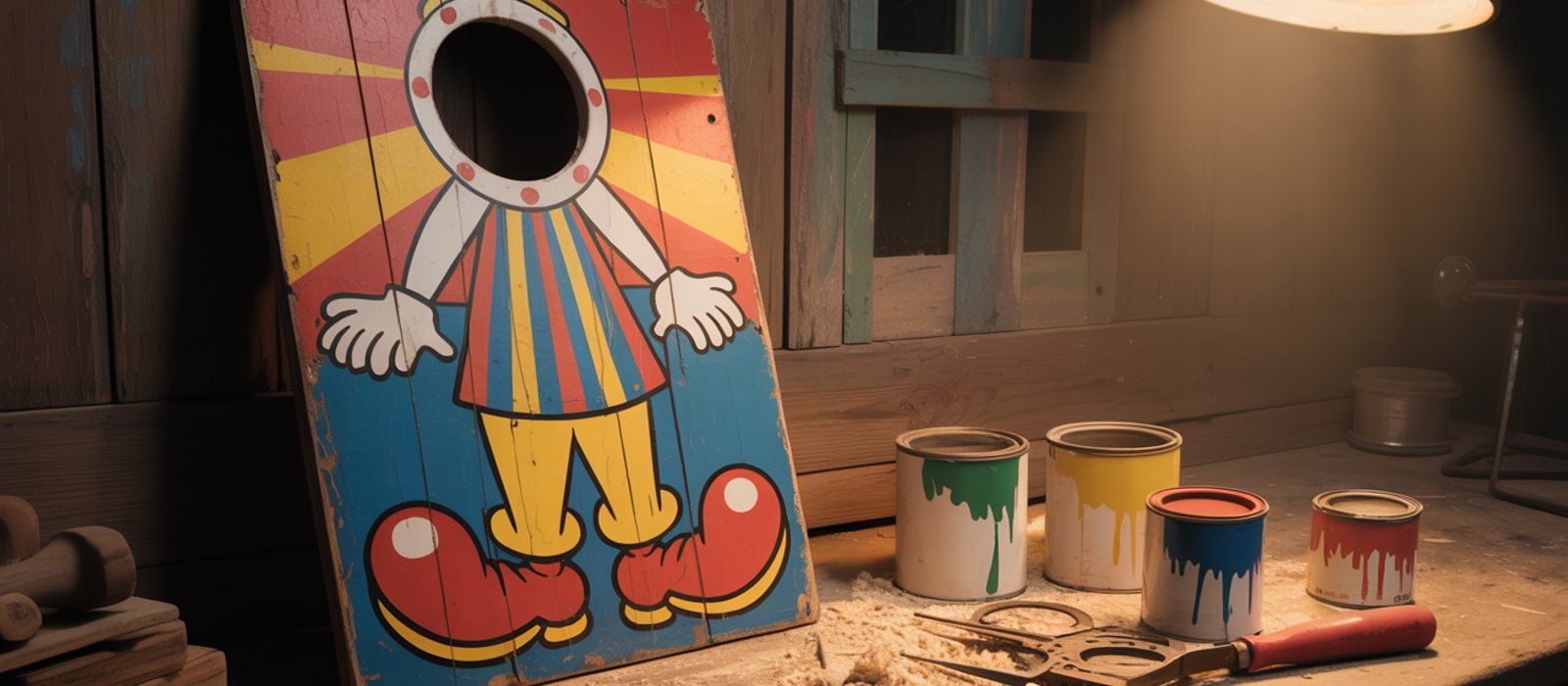
So you've been to an event, stuck your face through a hole in a board, had a brilliant laugh, and now you're thinking: how hard can it be to make one of those?
Genuinely not that hard. But also not as simple as cutting a circle in a bit of cardboard and calling it art. If you want something that looks good, survives a full day of use, and doesn't collapse mid-wedding-reception, there's a proper process to follow.
Here's the honest guide to making a face hole board — materials, method, pitfalls, and all.
What You Actually Need Before You Start
Let's skip the vague "gather your supplies" nonsense and get specific.
Board material is your first decision. Foam board is cheap and light, but it dents, warps, and won't survive being left in a car boot overnight. MDF (medium-density fibreboard) at around 6–9mm thickness is the go-to for anything built to last. It's heavier, but it holds paint well, takes clean cuts, and doesn't buckle under pressure.
For a standard standing board, you're looking at a sheet roughly 120cm x 150cm — big enough for two adults to use comfortably, but not so large it becomes a logistical nightmare.
Tools you'll need:
- Jigsaw or hole saw (for the face holes themselves)
- Sandpaper (80 grit and 120 grit)
- Primer and acrylic paint, or a vinyl wrap if you want photographic-quality finish
- A projector or printed template for scaling your artwork
- Prop stands or a sturdy wooden frame for the back
The face holes themselves should be roughly 20–22cm in diameter — large enough for most adult heads, small enough to still look like the character is wearing a body and not experiencing some kind of medical emergency.
Designing the Artwork
This is where most DIY builds either shine or fall apart completely.
The whole point of a face hole board is that the design is funny, visually striking, or on-theme for the event. A poorly drawn cartoon body with awkward proportions will produce awkward photos. A well-designed illustration will have people queuing up.
Your options for artwork:
-
Commission a local illustrator — best results, most expensive. Expect to pay £150–£400 depending on complexity. You'll want a high-resolution file (at least 300dpi at print size) for a clean finish.
-
Use a graphic design tool like Canva or Adobe Illustrator — works well if you're confident with design. Look for vector illustrations so they scale without going blurry.
-
Print and trace — project your design onto the primed board using a digital projector, trace the outlines in pencil, then paint by hand. This is the most satisfying method if you enjoy that sort of thing, and the most time-consuming if you don't.
Whatever route you take, plan the face holes before you finalise the design. The holes need to sit at a realistic head height for standing adults — typically around 155–165cm from the ground when the board is upright. Get this wrong and every photo looks like the subject is floating.
Once painted or printed, seal everything with a clear varnish or matte lacquer. Without it, your artwork will scuff and fade after a single event.
Building the Frame and Making It Stand Up
A face hole board that falls over is a face hole board that hurts someone. Don't skip this part.
The simplest approach is a wooden A-frame stand fixed to the back of the board — essentially two timber legs (50x25mm batten works well) joined at the top with a hinge and held apart at the base with a chain or length of cord. This lets you fold the stand flat for transport and open it up on site.
Alternatively, fix a horizontal timber batten across the back near the bottom, with two vertical legs extending down to create a wide, stable base. Less portable, but rock solid on uneven ground.
A few things to check before you declare it finished:
- Test it on different floor surfaces. Smooth floors and carpet behave very differently. Add rubber feet to the legs to stop it sliding.
- Check the weight distribution. If the board is taller than it is wide, it will topple forward easily. A cross-brace near the bottom of the back frame sorts this.
- Can one person carry it? If it takes two people and a van just to move it between rooms, you've built yourself a problem, not a prop.
For outdoor use, you'll also want to think about wind. Even a moderate breeze will send an unsecured board into your guests. Stake points or sandbag hooks on the base legs are worth adding if the board will be used outside.
When DIY Isn't Worth the Effort
Here's the bit the craft blogs leave out.
Making a decent face hole board — one that actually looks professional, survives repeated use, and doesn't embarrass you in front of 200 wedding guests — takes time, tools, and a reasonable level of skill across design, painting, and basic carpentry. Even if you already own half the tools, you're realistically looking at two to three full days of work and somewhere between £80 and £250 in materials, depending on finish quality.
For a one-off event? That's a significant commitment.
Professional face hole board hire typically starts at around £150–£250 for a weekend, delivered to your venue, ready to use, and collected afterwards. No offcuts in the spare room, no panic at 11pm because the varnish hasn't dried, no explaining to your partner why there's MDF dust on everything.
At National Self Portrait Gallery, our boards are fully bespoke, professionally illustrated, and built to last through proper events — not just survived them. We work with corporate clients, student unions, wedding venues, and charities across the UK, and we can create something that actually fits your event rather than something generically funny.
The Honest Takeaway
Making a face hole board yourself is genuinely achievable if you have the time, the tools, and a decent eye for design. The steps aren't complicated — good board material, well-planned artwork, proper face hole placement, and a stable frame.
But if the goal is a brilliant prop that lands well on the day rather than a weekend project that might come together, hire is almost always the more sensible call.
Either way, now you know exactly what goes into one. Which means you also know exactly what to look for when you're evaluating whether someone's hire board is actually worth the money.
Spoiler: ours is. Take a look at what we offer.